
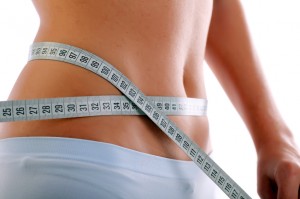
Measurements
Take your measurements so you have a starting point and you can track your progress:
1. Measure your chest
Measure the chest by wrapping the measuring tape under the armpits and around to the front of the chest at the widest part. For men this will be at the armpits, for women this will be at the nipple line.
2. Your waist
Measure the circumference around your natural waist and your lower waist. These are two separate measurements.
The natural waist is the smallest point of your waist and is usually an inch or two above your bellybutton.
Your lower waist is the widest part of your waist, usually at the bellybutton or just below, where weight is generally gained first.
3. Measure your hips
Measure the circumference around your hips at the widest point.
4. Measure your upper thigh
Measure the circumference around your upper thigh at its widest point. This is usually ½ to 3/4’s of the way up your thigh, from the knee. . Measure each thigh and record the numbers separately.
5. Measure your calves
Measure the calf muscle by wrapping the measuring tape around thickest area of the muscle. This is approximately the halfway point from the knee to the ankle. Measure each calf and record the numbers separately.
6. Measure your upper arm
Measure the bicep area of the arm by wrapping the measuring tape at the point halfway from the elbow to the armpit. Keep your arm relaxed to get a measurement of the arm in a natural state.
7. Measure your weight
For weight monitoring, you may include your body weight as a body measurement. You might not notice as much change here, as you will be gaining muscle, which weighs more than fat. A better indication of weight-loss is how your clothes fit.
8. Measure your height
The easiest way to measure your height is to stand straight with no shoes on and place your back against a wall. Using a pencil, place the pencil flat against the top of your head. Carefully mark your height against the wall. Step away and measure from the mark down to the floor using your tape measure.
9. Set
SMART goals for yourself and have a plan. Make your goals Specific, Measurable, Action-based, Realistic and with a time frame.
Specific: I want to lose weight is not specific but I want to lose 2.5 kilos in 4 weeks is.
Measure: Take your measurements with a tape measure. Measure exactly the same way each time, and if someone else is doing it for you get the same person to do it each time so the results are consistent.
Action-based: Set up a step by step plan to follow in order to achieve your goals. What workouts and how many will you need to do each week? And what foods will you need to eat for optimal gain?
Realistic: Be realistic when you’re setting a goal. ‘I want to lose 5 kilos in 1 week is just not possible, you’re setting yourself up to fail.
Time frame: When setting goals always have a finish date or a review date to set new goals. A 28 day challenge is great as it is a perfect amount of time to make change while setting you up with good habits.
After each workout, write down how you did and how you felt. How many rounds, reps, and what was the time you did. Make sure you measure so you have something to refer back to, which in turn will help to keep you motivated.
If you used weights, what weight did you lift?